

$69.50
See if it's really the one
Search with this product to compare it, find similar styles, or turn up something better before deciding.
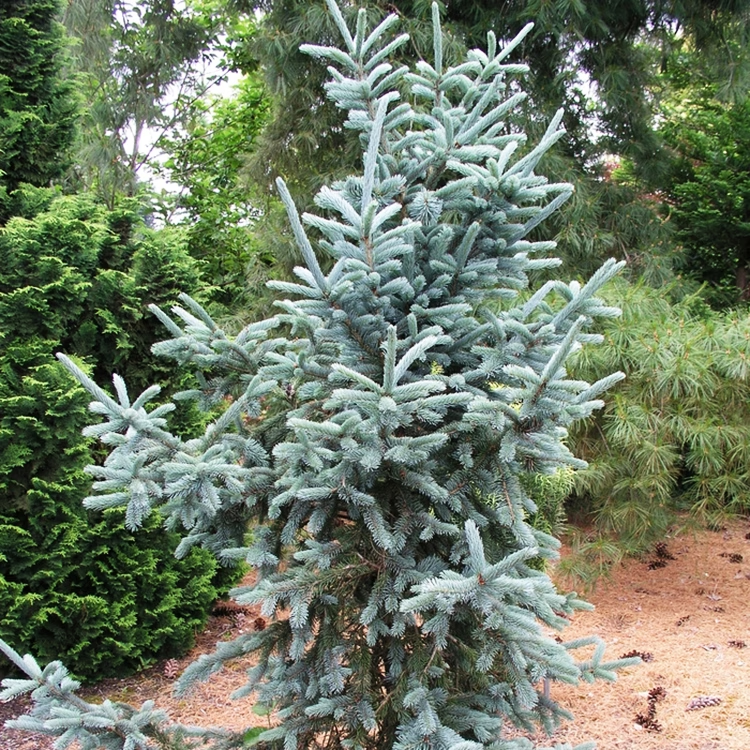
Spruce trees remain the most popular of all conifer evergreens, especially in colder zones, where choices are more limited. The most popular of all is the blue, or Colorado spruce, Picea pungens. Almost as popular is white spruce, Picea glauca, (which is only ‘white’ from the waxy coating on the older needles). White spruce is a major tree for forestry, lumber and paper, while blue spruce remains the gardener’s favorite. In many gardens we often see Norway spruce, Picea abies, which isn’t a native tree. As well as those species, North America has black spruce, Picea mariana, which is found mostly in Canada, and Engelmann’s spruce, Picea engelmannii. That last species is native to western North America, and an important forestry tree. Although much less grown in gardens, Engelmann’s Spruce is notable for its more pendulous foliage, giving it a graceful look. Like the blue spruce it varies in leaf color, typically greenish, but in some individuals it is gray-blue, and these plants make the best garden varieties, since ‘blue’ spruce are far and away the most popular forms for gardens. It always pays to choose a named variety, as even seedlings from a blue plant will not often be strongly blue. Now regular spruce trees are very large, so in gardens it is best to choose forms which stay small. If you are looking for a ‘blue spruce’, try something a little different, with more elegance, the same blue foliage, and a compact size – like Vanderwolf’s Blue Pyramid Spruce. Using the Vanderwolf’s Blue Pyriamid Spruce in Your Garden A blue spruce is often the first purchase for a new garden – and often the first problem, since we see many trees crowded against a house, or taking up the whole yard. Avoid that problem with Vanderwolf’s Blue Pyramid Spruce, which grows only to 10 or 12 feet, giving you all the beauty, but none of the problems. Plant it out on a lawn as a specimen, or grow it around your home among other evergreens for the foundation planting. It makes a great contrast with trimmed, dark-green plants. Grow it on a slope, or in a dedicated area alongside a variety of other small evergreens – a terrific and easy way to make a great garden feature, perhaps interspersed with boulders, and mulched with gravel. It looks great in a large rock garden, and is also a great choice for a large planter. Although small, do give some thought to spacing, allowing 4 feet between it and a wall, fence, or other plants (plus the allowance they need, of course). Growing the Vanderwolf’s Blue Pyriamid Spruce Size and Appearance Vanderwolf’s Blue Pyramid Spruce is a small, evergreen tree, growing 6 or even 8 inches a year, to be about 7 feet tall and 4 feet wide in 10 years. Conifer trees never stop growing, so a mature tree will be double those dimensions, and eventually even more, so this should be considered when placing it in your garden – mature evergreens are very valuable! It has a dense, full look, with a characteristic downward form to the stems. The growth is narrow, making this a great spruce choice if you have limited space available. The bark is reddish-gray, and thin, flaking off in small plates, and the branching is dense, making a bushy plant. The needles are about ¾ of an inch long, densely covering the stems, and circling around them. They are a rich blue-gray, most prominent in spring on the new growth, but persisting well throughout the year, including the winter months. This species produces hanging cones up to 3 inches long, purple at first and light brown when mature, but these may never be produced on this variety, or only on an older tree. Hardiness Hardiness This tree comes from high altitudes, so it is very cold tolerant, surviving well in zone 2 and all the colder zones. It’s a great choice if you have very cold winters. It grows well into zone 7, but we don’t recommend it for warmer areas. Sun Exposure and Soil Conditions For good growth you should plant your Vanderwolf’s Blue Pyramid Spruce in full sun, in any well-drained soil. This species tolerates, and indeed prefers, moist soils. It will grow well in heavier soils, but not so well in solid clays, or in dry, sandy soils. Water young trees regularly, until they become established but an established tree will have sufficient drought tolerance to grow fine in dry periods in colder zones. Maintenance and Pruning Deer don’t eat Vanderwolf’s Blue Pyramid Spruce, and it rarely has any pests or diseases worth mentioning. It needs no special attention, although a little evergreen fertilizer scattered around the roots in spring will be appreciated. You can let it grow as it wishes, but it is best to select one, single stem to form the main trunk. Just keep one stem at the top, growing upwards. If you see multiple stems, trim back all but one, leaving it well above the others. A single trunk gives the most elegant form, and is much less likely to break in a storm. It isn’t necessary to trim your tree – the natural form is preferable, but if you do trim or prune it, be careful not to cut back beyond areas with needles on them. Bare stems will never re-sprout. History and Origin of the Vanderwolf’s Blue Pyriamid Spruce Englemann’s spruce, Picea engelmannii, is a tree native to western North America, found mainly from British Columbia to southern Oregon, in the Rocky mountains and the Cascade mountains. Scattered populations can be found through Colorado, New Mexico, Arizona, and even in northern Mexico. It favors higher altitudes, up to 12,000 feet, often forming the uppermost trees in the mountains. It is a large tree, generally growing over 100 feet tall, and sometimes over 200 feet. This makes it unsuitable for most gardens, but luckily there are smaller forms, like Vanderwolf’s Blue Pyramid Spruce. In the 1960s Pete Vanderwolf was a grower for John Vermeulen & Son Nursery, Neshanic Station, in New Jersey. One day he spotted a unique tree among a batch of seedlings of Englemann’s spruce, with a small form and striking blue needles. It was separated from the others, and named ‘Vanderwolf’s Blue Pyramid’. It’s a pity Pete didn’t have a lot of imagination, it seems. There is also a selection of a limber pine tree called ‘Vanderwolf’s Pyramid’, which shouldn’t be confused with this spruce tree. Buying the Vanderwolf’s Blue Pyriamid Spruce at The Tree Center Special trees like Vanderwolf’s Blue Pyramid Spruce can only be propagated by grafting pieces derived from the original plant onto roots of seedling spruce trees. That’s how our trees have been grown, and that requires skilled and trained professional grafters. It always pays to check this, as unscrupulous nurseries often sell seedlings as if they were the original, which they definitely aren’t. Correctly-grown varieties are always in short supply, given the skill, patience and time needed, and we have just a few available. So order now for something different in a blue spruce, you won’t regret your excellent choice.
Have a question about this?
We currently ship within the US, with more countries coming soon.
Final cost and dates are confirmed at checkout.
🇺🇸 Ship from USA · On Agora since 2026
$69.50