See if it's really the one
Search with this product to compare it, find similar styles, or turn up something better before deciding.
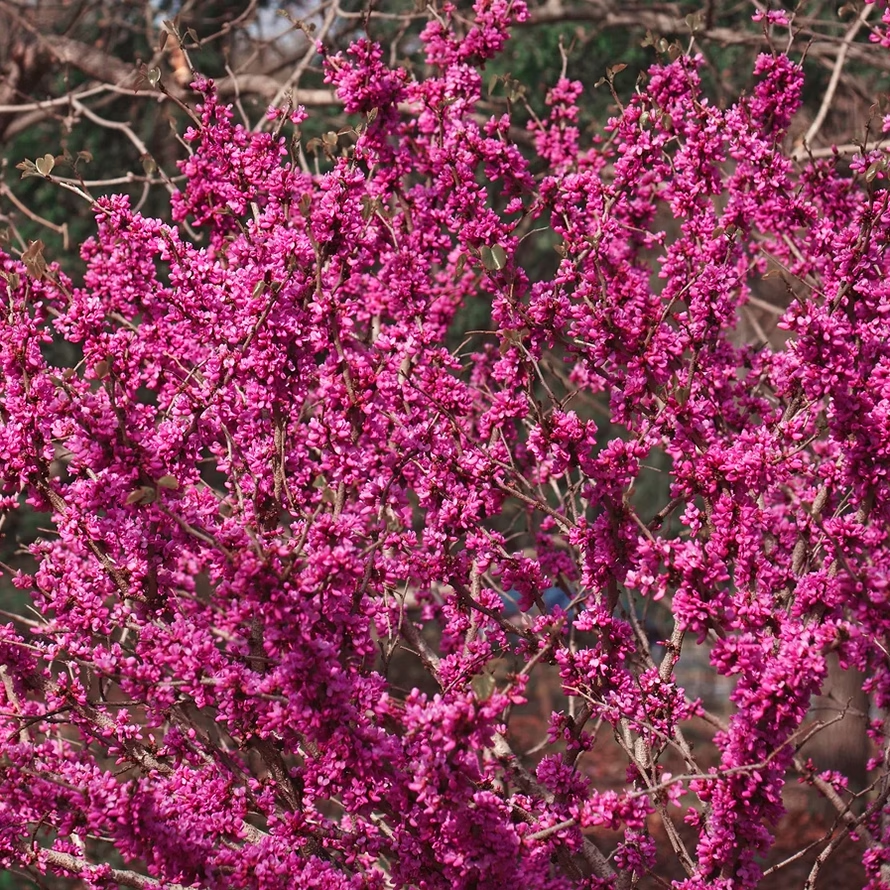
Not all things that look much the same really are the same. Take redbud trees. Botanists continue to dispute just how many species there really are in North America, and although often called Judas tree, it is really the European species that should have that name. Then there is Asia, because there are several redbuds native to different regions there too. The most striking is the Chinese redbud, and one of the best varieties of that tree is the Don Egolf Redbud. Raised from seed gathered in Yunnan, it flowers a little earlier, with slightly larger flowers; easily develops a single, central trunk; is more compact with a crown of horizontal branches; has glossier, more handsome leaves; and most importantly, stays smaller. It is typically around 10 to 12 feet, making it an ideal choice for smaller gardens, where our 25-foot native species is going to be too big. Other than all that, it is much like our native tree! Using the Don Egolf Redbud in Your Garden You can plant the Don Egolf Redbud just as you would a regular redbud, but since this one normally has a central trunk, it is great planted in a lawn, or at the edge of your garden near larger trees. Use it too to give extra height in a shrub bed, without it taking up much room at ground level. Use it in a small courtyard garden, since it won’t get too large, or plant it in a corner, perhaps in the angle of two blank walls around your house. It’s a great addition to an Asian-inspired garden, and a good foil for Japanese maple and pine. Growing the Don Egolf Redbud Size and Appearance The Don Egolf Redbud is a small tree, usually, and unlike most other redbuds, with a central trunk, forming a tree with a dense crown. It is relatively slow-growing, and will reach no more than 10 feet tall in 15 years, and one day it might get to 12 feet or a little more. It has a rounded crown, usually about as wide as it is tall, or a little less in time, so allow enough room for a spread of 10-12 feet when choosing a planting spot – you don’t want it to be crowded among other plants. The branches grow more horizontally than is typical for a redbud, giving it an attractive, mature, twisted look, even when still quite young. Many even droop downwards, creating a look that is gentle and almost pendulous – but not quite. The bark is relatively smooth, and very dark gray-brown, often approaching black. Foliage appears after the flowers in spring, and leaves are up to 5 inches long, and almost as wide. They have a pronounced heart-shape, and taper to an elegant tip. They are very glossy and smooth, and a rich, deep-green. In fall they turn yellow, ending the year softly. Flowering takes place in spring, up to a couple off weeks before our native redbud, on bare branches. This is one of the very first trees to bloom in the year. The flowers are carried in clusters all along the branches, even on older, thicker ones, giving a very profuse flowering. Even the trunk may have flower clusters on it. In groups of up to 8, individual flowers are somewhat larger than on the native redbud, approaching ¾ of an inch in length. They resemble the flowers of pea plants – redbuds are in the same family – and are a vibrant purple-pink color, which really shines out across your garden, and can be visible for miles, especially since other trees are still bare. The normal brown, woody seed pods of redbud are not produced on this particular variety, which is no loss. Hardiness Not quite as hardy as our native redbud, you can grow the Don Egolf Redbud from zone 6 into zone 9. It has good tolerance of hot, humid weather. Sun Exposure and Soil Conditions The ideal spot for your Don Egolf Redbud is in full sun, a location that will give you maximum flowering. In zone 9 some afternoon shade can be helpful, especially in dry periods. Although enjoying sun, this tree does enjoy company, and prefers to be close to larger trees, rather than out in a blank expanse of lawn. It is very undemanding when it comes to soil, anything well-drained will be fine. It does grow best in a richer, somewhat moist soil, but will be fine in everything from sandy soil to heavy clay, just so long as it isn’t wet. Adding plenty of compost to the planting spot will even out differences, and create a good environment for your trees. It also doesn’t mind if the soil is acidic or alkaline. Your new tree should be watered regularly, but once established it is drought tolerant, although still enjoys a deep soak during extended dry periods. Maintenance and Pruning This tree is normally left alone by deer, and it has few serious pests or diseases. Since it is naturally compact, there is normally no need to prune or trim it – just let nature guide it to a beautiful, natural form. History and Origin of the Don Egolf Redbud Redbud trees are found in Europe, North America and in Asia. The European species, Cercis siliquastrum, is often called Judas tree, since legend has it that Judas Iscariot, the disciple of Jesus who betrayed him, hanged himself from it. In North America current research suggests there are three species, with the eastern redbud, Cercis canadensis, being by far the most important one. In Asia there are several rather obscure species, and one, Cercis chinensis, which is found all across China, and also widely grown there in parks, gardens and city streets. Wild trees can reach 50 feet, but more often it is smaller, and trees outside China are almost always much more compact. In the late 1980s the US National Arboretum in Washington obtained a batch of seeds of the Chinese redbud that had been collected from trees growing in the city of Kunming, in Yunnan province, China. Some of these were grown into plants, and in 1992 Ruth Dix, at the Arboretum, selected one for its attractive broad shape, compact size, profuse flowering and the lack of seed pods. In 2000 Dr Margaret Pooler, of the Arboretum’s Agriculture Research Service, registered it with the name ‘Don Egolf’. He was one of the Arboretum’s most distinguished and famous plant breeders. It was released to nurseries freely, for the pleasure of American gardeners. Buying the Don Egolf Redbud at the Tree Center A unique tree, and perfect as your first redbud, or to add to your existing collection, to enjoy the subtle differences from our native trees. Its compact size makes it a great choice for everyone with a small garden, because no one should be without a redbud, one of the very best of the spring-flowering trees. Still relatively new to gardeners, the Don Egolf Redbud is sure to please, and add an exotic touch. We don’t know when we will have some again, so order yours now – don’t miss out.
Have a question about this?
We currently ship within the US, with more countries coming soon.
Final cost and dates are confirmed at checkout.
🇺🇸 Ship from USA · On Agora since 2026
$129.50