

$1,895.00
Checking availability
See if it's really the one
Search with this product to compare it, find similar styles, or turn up something better before deciding.
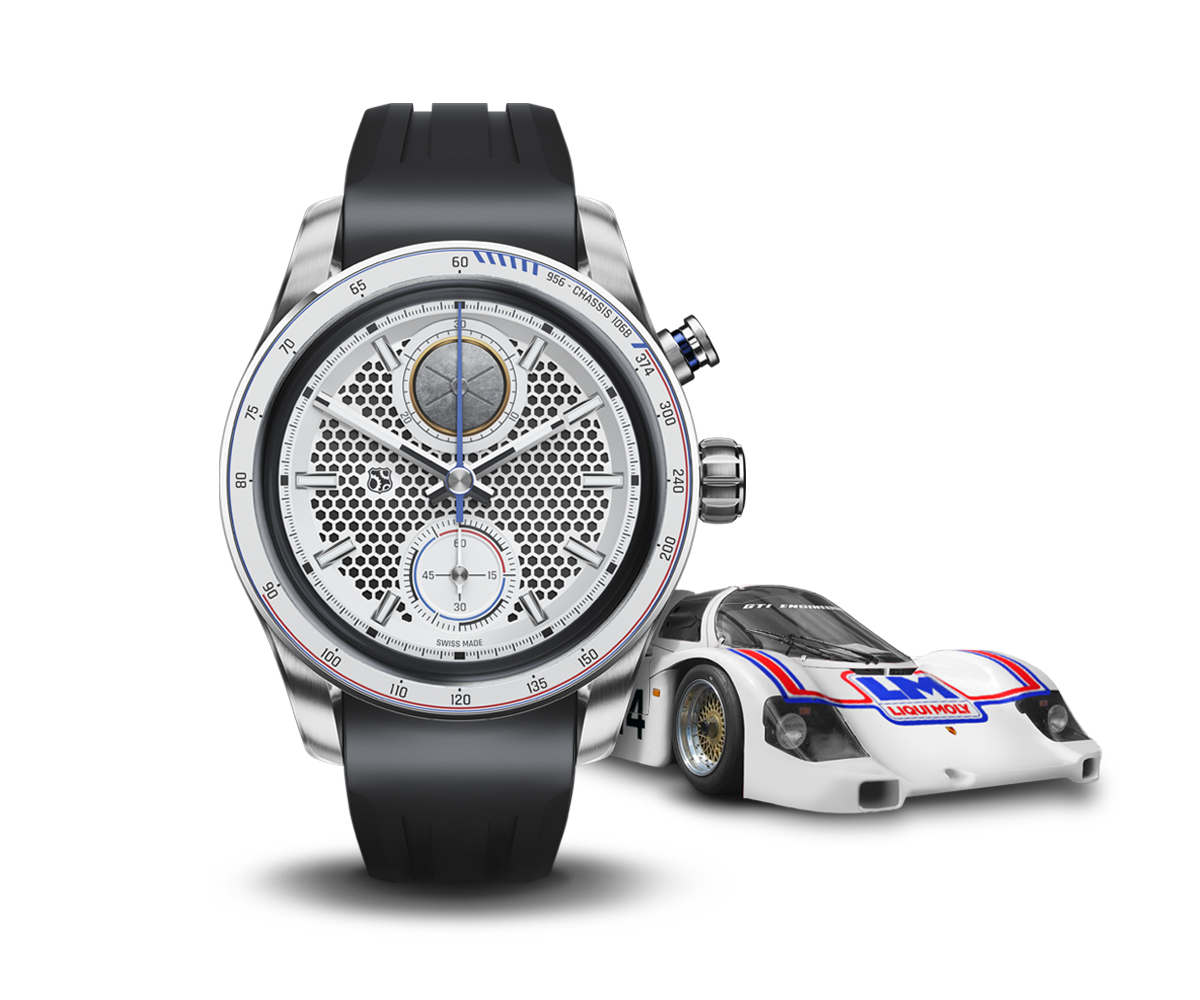
font-size: px; } } USD EUR GBP DKK USD EUR GBP DKK Add to bag USD EUR GBP DKK USD EUR GBP DKK Add to bag Add to bag Project 956-106B DNA Edition The 956-106B Series is a limited DNA-Edition, Swiss-made mono-pusher chronograph featuring a subdial crafted from the repurposed brake disc bell of Porsche 956 chassis no. 106B. Originally built for Richard Lloyd’s GTi Engineering, the car was re-engineered with a honeycomb monocoque to challenge Porsche’s factory dominance. As 956-106 “B”, it placed 2nd at Le Mans 1985 before a crash at Spa — where driver Jonathan Palmer credited the chassis for saving his life. Available in two liveries, this timepiece fuses motorsport heritage with Swiss precision, honoring a machine that defined an era. Split your payment over 12 months (at no extra cost). Specifications Dimensions Case diameter: 41,00mm Opening diameter: 34,00mm Lug-to-lug: 49,50mm Height: 13,60mm Movement Calibre name: Sellita SW562 MP Calibre type: Cam operated chronograph, Automatic, Swiss Made Custom rotor Power reserve: 62 Hours Frequency: 28’800 vibrations per hour (4 Hz) Jewels: 29 Accuracy: ±5 seconds per day Functions: Hours and minutes display in the center, small second at 6 o’clock. Chronograph counters: 60s and 30 min. Automatic & manual winding Features Chronograph 30 min. counter crafted from the repurposed brake disc bell of Porsche 956-106B 316L stainless steel case with skeletonized lugs Double domed Sapphire crystal w. 3 layers anti-reflect coating Exhibition caseback w. custom rotor Swiss Super-Luminova X1 on hands and indices Rubber strap with Quick-release system, 20mm width Water resistance 5 ATM, 50 meters Materials Case, crown, pushers & clasp: 316L Stainless steel Top glass: Sapphire crystal w. 3xAR Coating Strap: FKM rubber strap, single injection Strap dimensions Width at lugs: 20,00mm Width at clasp: 18,00mm Strap length: 122mm/92mm Legal disclaimer REC Watches and its products are not in any way associated or supported by Porsche AG or any of its affiliates. Why did REC develop this timepiece? A Decade of Expertise The Porsche 956’s history is truly fiction-like and almost unbelievable. At REC, we exist at the intersection of two worlds: the love and nerdiness for iconic vehicles, and the passion for watches. Naturally, we knew the 956 story was one we eventually had to tell. For more than a decade, we’ve been honoring icons, transforming the DNA of history’s finest machines into timepieces. Our track record includes Carroll Shelby’s ‘Little Red’ Mustang, Ayrton Senna’s F1 Lotus 98T, and the first production GT40 car ever – alongside drift cars, spy planes, WWII aircraft, movie cars, off-roaders, and famous sports cars. It was incredible to sit down with the owner of chassis 106B and collaborate with legendary designer Professor Peter Stevens. And before we knew it, the 956-106B project was born. Stevens, famous for designing the McLaren F1, has deep racing roots. In the mid-80s, he was the lead aerodynamicist and team owner Richard Lloyd’s right-hand man during the campaign of the 956-106B. “A race car is beautifully detailed, and one of the things that I’d liked when we first talked about the idea of the watch is that there would be detailing on the watch which referenced areas of the car, particularly areas of the car that we enjoyed developing.” Professor Peter Stevens Lead Designer & Legendary Vehicle Designer Read less Read more The Blueprint of Modern Endurance Racing The Porsche 956 When Porsche revealed the 956 in 1982, endurance racing tilted on its axis. Group C regulations favoured efficiency over raw power, and the new car exploited every clause. The aluminium monocoque was the first in Porsche history. It paired with a 2.65-liter turbo flat-six lifted from the Le Mans-winning 936 and detuned for reliability, not restraint. The real breakthrough lay underneath. Full ground-effect tunnels generated immense downforce without massive rear wings, allowing unprecedented corner speeds while retaining low drag for the Mulsanne straight. Results arrived immediately. The 956 locked out the 1982 Le Mans podium and repeated the sweep in 1983 and 1984. Stefan Bellof’s 6:11 lap at the Nürburgring 1000 km in 1983 held as the Nordschleife benchmark for thirty-five years, a feat still whispered about in pit lanes. Porsche then broke with factory tradition by selling the car to customers. This single decision fertilised a garden of privateer innovation. Joest, Kremer and especially Richard Lloyd Racing treated the 956 as a blank canvas, proving that creativity could rival Weissach budgets. The 956 became more than a model. It evolved into the template for modern endurance development, influencing everything from chassis design to aerospace-style project management. Its DNA still threads through contemporary LMDh contenders. Read less Read more Out-Innovating the Factory, Lap After Lap Richard Lloyd & Porsche 956-106B British privateer Richard Lloyd suspected favoured treatment flowed to German teams. He chose to outthink rather than outspend. Chassis 956-106 arrived at Richard Lloyd Racing in early 1983, and in its first year of racing, the team achieved a few respectable podium finishes. Then, in ’84, they secured an overall victory at the Brands Hatch 1000 km. Even though they had just achieved an important win, Richard Lloyd Racing knew that when it came to Le Mans, they needed a drastic change, a competitive advantage over the factory entries. After identifying a weakness in the standard 956 chassis, designer Nigel Stroud created a new aluminium honeycomb tub with increased longitudinal stiffness that could potentially beat the factory team. He also added a two-plane rear wing, a deeper splitter, and occasional nose winglets. The rebuilt chassis was recognised by Porsche and christened 956-106B. At Le Mans in 1985, it outran the factory entries. But in a twist of irony, it was beaten by another privateer Porsche 956. Still, it had made its point, finishing on the podium and ahead of all factory cars. Spa dealt the next chapter. Jonathan Palmer suffered a 250 km/h impact; the tub sacrificed itself and saved the driver. Stroud constructed a second honeycomb shell, and the machine returned as 956-106B2. Canon colours bowed out after one more start; Liqui Moly branding carried the car through 1986. Bob Wollek and Mauro Baldi won the Brands Hatch 1000 km, providing a last hurrah before safety rules sidelined every 956. The original 106 tub found service with Brun Motorsport, assisting their 1986 Teams’ Championship. Even when sold, the chassis continued to embarrass the establishment. Read less Read more From Dawn Treader Stewardship to Track-Ready Timepieces Living Legacy: 956-106B Today Few Group C cars exist as they were. Chassis 106B2 remains an authentic headline act. Patrick Morgan acquired the Porsche in 2008 and undertook a near ten-year restoration. Winters bring crack inspection and NDT analysis; summers see world class events like the Goodwood Festival of Speed, where this car has set scintillating times. Longevity demands attention to detail. Morgan has painstakingly preserved as many original components as possible, spending over three months on the bodywork repair and fit alone. Every nut and bolt has been cared for, the chassis and suspension undergoing full NDT inspection, the aging fuel cell faithfully replicated. Period techniques have been used throughout – 106B was built in 1984 and respect has been paid to the team members that folded, glued and polished the honeycomb chassis to preserve their efforts. Every original part has been preserved, however those that have exceeded their functional life have been used to make this watch something very special. The 956 remains a touchstone for analogue efficiency: nine hundred kilograms, two bar boost and Peter Stevens’ ground-hugging downforce made 106B an exceptional design. It personifies privateer audacity, the trait that separated Lloyd’s team from mediocrity. Because 106B2 has been preserved so carefully, its continuity validates each lap and every spin of the BBS chronograph rotation. The story is alive, not archived. Read less Read more
Have a question about this?
We currently ship within the US, with more countries coming soon.
Final cost and dates are confirmed at checkout.
🇺🇸 Ship from USA · On Agora since 2026
$1,895.00