




We came close to buying our own GPU servers.
We had a spreadsheet that said it would save us money. We had quotes from seven vendors in Madrid: two hardware resellers, four colocation providers and a network carrier. We had a rack picked out. Then we finished the model, and it said that buying two servers would take until year nine to beat renting them.
So, we kept renting.
This post covers how we got to that answer. It explains why we looked at buying in the first place, how we went to market, what each proposal said, how the model works, and what we would tell another team facing the same decision. Every number in it comes from a real quote or from our internal cost model. Where we have made an assumption, we say so.
The short version
We pay $7,200 a month to rent two GPU servers. That works out to about $2.47 per GPU-hour, all-in, which is already near the bottom of the market.
Buying the cheapest equivalent would cost $354,100 upfront. That includes 21% Spanish VAT (IVA), which we cannot recover. Running the servers in a Madrid data center would cost about $39,850 a year.
The savings are real but small. About $46,550 a year, against $375,700 of cash spent before the first saving arrives.
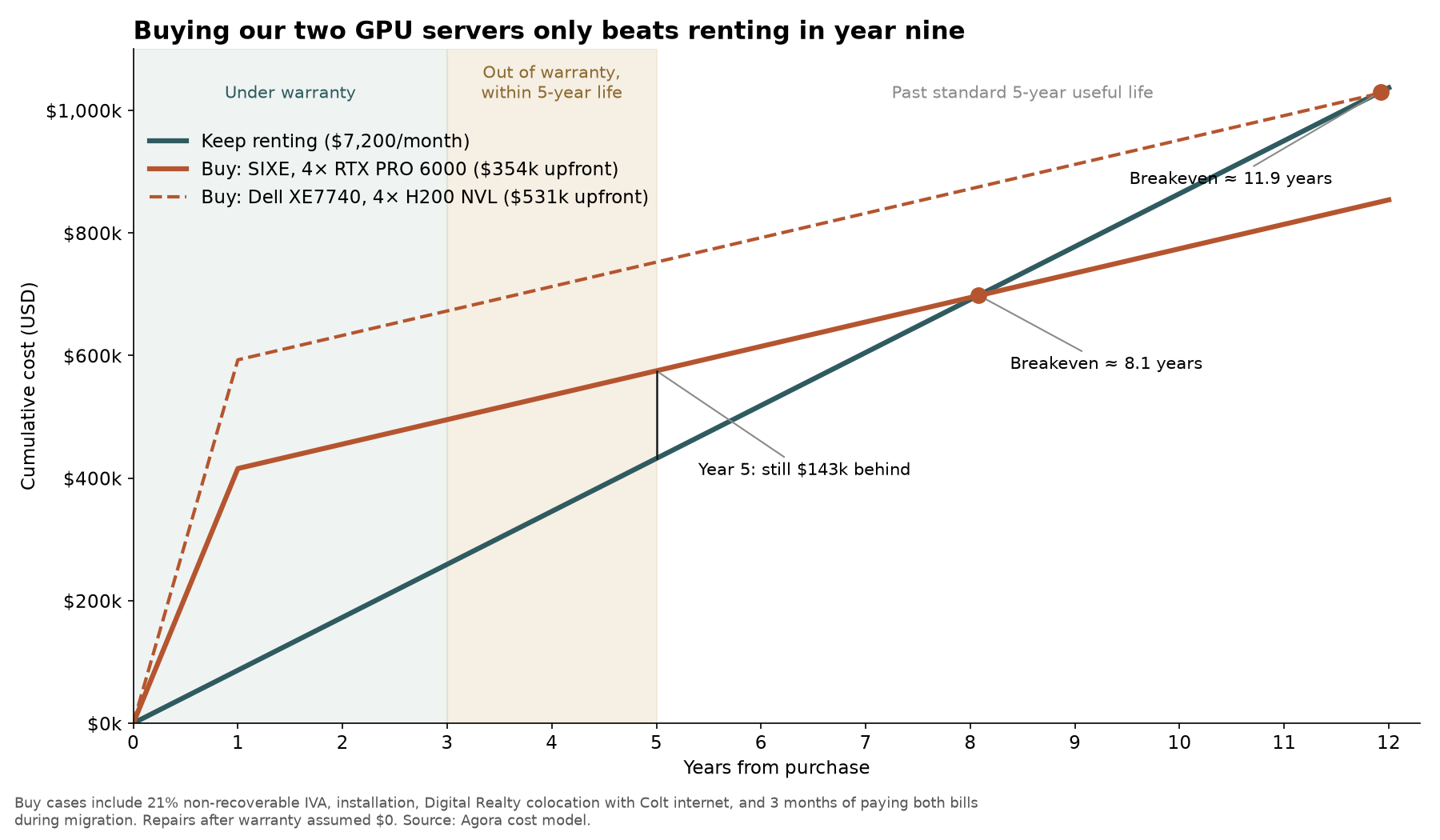
Payback takes just over eight years. The hardware has a three-year warranty and a standard five-year useful life. At year five we would still be $143,000 behind.
No single change fixes it. A cheaper data center, a bigger fleet, or recovering the IVA all help. None of them brings payback inside five years.
The biggest variable is what you pay to rent today. At the 2026 on-demand median for an H100, the same purchase pays back in under five years. At our rate it does not.
Where we started
Agora runs most of its AI on its own models. Query planning, reranking and product embeddings are served from GPUs we control, and the search models are retrained every day on the previous day's logs. We wrote about that system in "Building a reinforcement learning system for e-commerce search". Self-hosting is what makes that loop possible. It also makes GPUs one of our largest infrastructure costs.
Today that work runs on two rented servers, each with two NVIDIA H100 PCIe GPUs. The bill is $7,200 a month, or $86,400 a year. It covers the GPUs, the rest of the server, hosting, power and hardware maintenance. Divided across four GPUs running every hour of the month, that is about $2.47 per GPU-hour.
Three things made us question that bill.
Rental prices were rising. For most of 2024 and 2025, renting a GPU got cheaper every quarter. That stopped. SemiAnalysis reported that one-year H100 rental contracts rose almost 40%, from $1.70 per GPU-hour in October 2025 to $2.35 by March 2026. On-demand prices followed. Nebius listed its H100 at $2.95 an hour in May, according to Yahoo Finance, and its pricing page shows $4.50 from October 1, 2026. The median on-demand H100 across 40 providers was $3.42 an hour at the end of September, 15% more than a year earlier, according to GetDeploying data cited by DataStorage.com.
Our usage was going to grow. When we asked for quotes, we told every data center the same thing: we run two GPU servers today, about 3 to 5 kW, and expect to grow to several racks in the next 18 to 24 months. If we were going to own hardware, it made sense to decide before that growth, not after.
The conventional wisdom says owning is cheaper. It often is. 37signals moved its applications off the public cloud onto about $700,000 of Dell servers and recouped the whole purchase within a year, according to ITPro. If it worked for them, we wanted to know whether it would work for us.
So we priced it properly.
How we went to market
We started by writing down what we needed, in one paragraph, and sent the same paragraph to every vendor:
Start with half a rack to a full rack in Madrid.
Two GPU servers today, about 3 to 5 kW, growing to several racks over 18 to 24 months.
Power density per rack matters more than floor space.
Go-live in Q4 2026 or Q1 2027.
We own and operate the hardware. We need space, power, cooling and connectivity.
Madrid was an easy choice. It is where our team is, it has a dense cluster of carrier-neutral data centers, and it keeps the hardware close enough that someone can drive over when something breaks.
We split the problem into three markets, because they are bought separately and priced differently:
Hardware. The servers and GPUs, bought outright.
Colocation. A rack, power, cooling and physical security in someone else's building.
Connectivity. Internet transit and cross-connects into that building.
We built the cost model first, in June, using estimated prices. Then, as each quote came in, we replaced an estimate with a real number. That order turned out to matter. The model told us which inputs were worth chasing, and the quotes showed us how wrong our estimates had been.
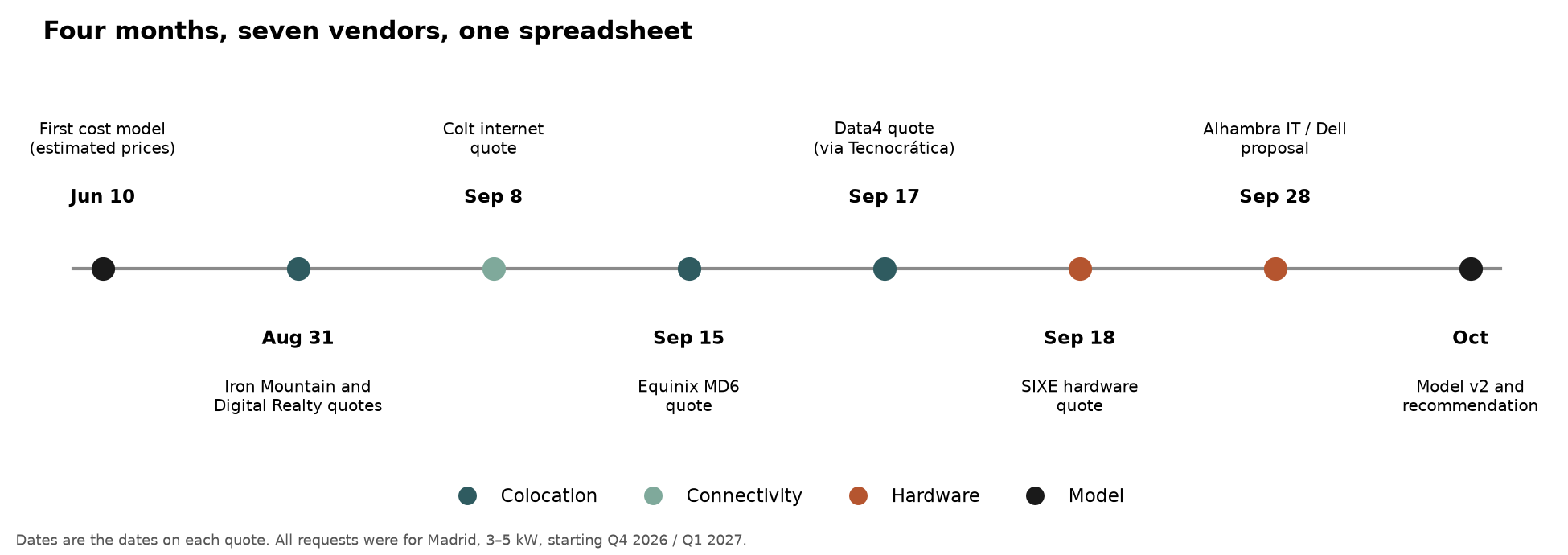
Over about four months we collected seven proposals:
Vendor | What they quoted | Date |
|---|---|---|
Iron Mountain | Colocation, MAD-1, 5 kW cabinet with internet | Aug 31 |
Digital Realty | Colocation, Madrid campus, 2 kW and 5 kW racks | Aug 31 |
Colt | Dedicated internet access at Iron Mountain and Digital Realty | Sep 8 |
Equinix | Colocation, MD6, 5 kVA secure cabinet with internet and cloud fabric | Sep 15 |
Data4 (through partner Tecnocrática) | Colocation, 3, 5 and 7 kW racks, plus transit | Sep 17 |
SIXE | Two Supermicro GPU servers | Sep 18 |
Alhambra IT | Two Dell GPU servers, with managed colocation at Digital Realty | Sep 28 |
What the colocation quotes said
All four colocation providers quoted a single rack with 5 kW of power. Put side by side, the monthly prices are closer than we expected.
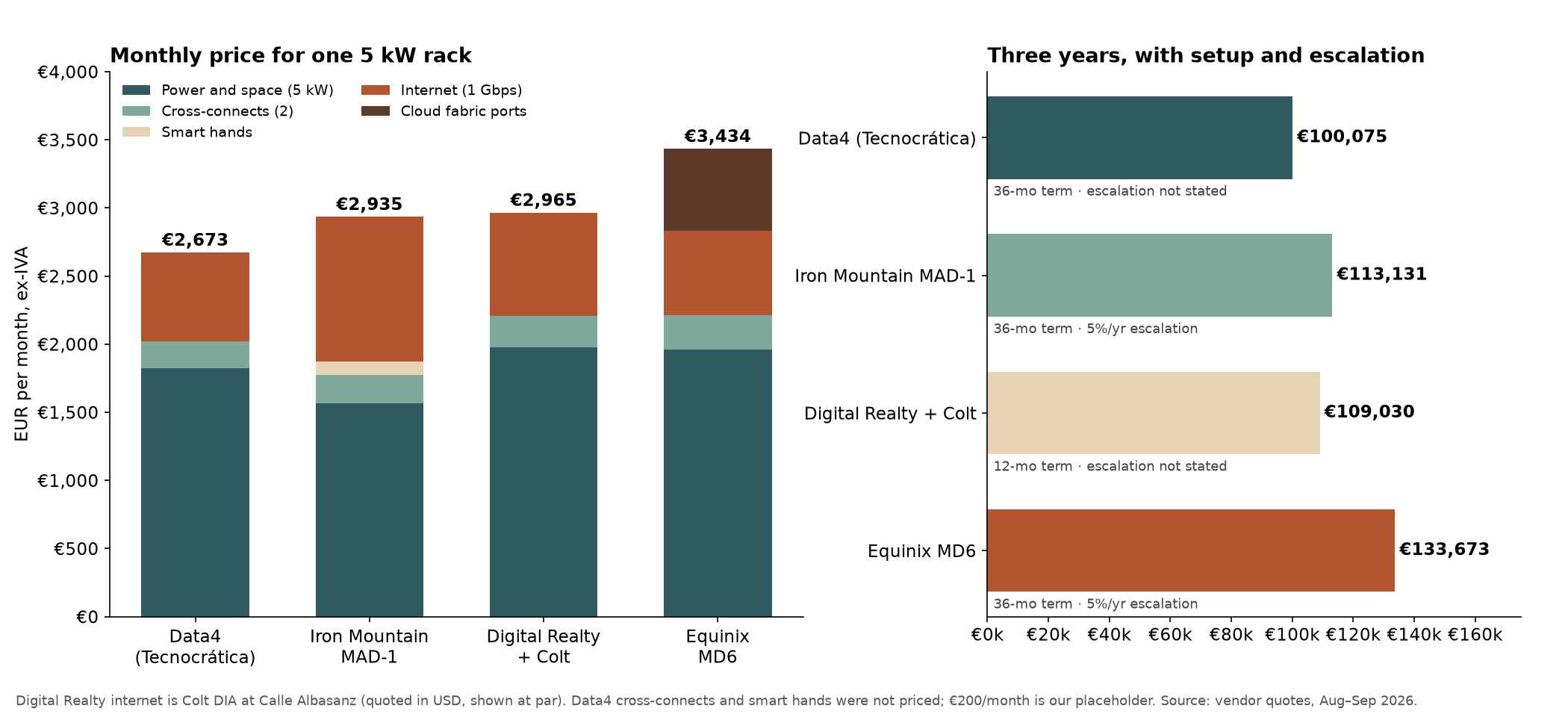
Data4 (Tecnocrática) | Iron Mountain MAD-1 | Digital Realty + Colt | Equinix MD6 | |
|---|---|---|---|---|
Power and space, 5 kW | €1,823 | €1,565 | €1,975 | €1,960 |
Cross-connects (2) | €200 (not quoted) | €210 | €230 | €250 |
Smart hands | Not quoted | €100 (1 hour) | €200 an hour, ad hoc | €165 an hour |
Internet, 1 Gbps | €650 per Gbps, 95th percentile | €1,060 (1 + 5 Gbps commits) | €760 (Colt) | €624 |
Other | €600 (fabric ports, AWS link) | |||
Monthly total | €2,673 | €2,935 | €2,965 | €3,434 |
One-time setup | €3,850 | €2,100 | €2,290 | €3,765 |
Minimum term | 36 months | 36 months | 12 months | 36 months |
Annual escalation | Not stated | 5% compounded | Not stated | 5% |
All prices exclude IVA. A few things stood out.
Power is most of the bill. In every quote, power and space is more than half of the monthly cost, and up to two thirds. Electricity is bundled into the per-kW price, so the number you choose for power is the number that sets your bill. Data4 put it plainly: the monthly fee follows the kW you contract, not the number of racks.
Terms matter more than the headline price. The spread between the cheapest and most expensive monthly total is about €760. The difference between a 12-month and a 36-month minimum term, or between flat pricing and 5% a year compounded, matters more over the life of the contract. Iron Mountain told us it had seen escalation as low as 3% for larger footprints, and offered a 3-6-9-11 month ramp so we would not pay for full power from day one. Neither was in the written quote.
GPU density forces decisions early. Data4 offers single-phase racks up to 7 kW. Above that, the rack moves to three-phase power, and the €4,850 setup fee is charged again because the rack's electrical installation is replaced. Alhambra's proposal recommended a 7 kW rack for its two Dell servers. If your GPUs will outgrow single-phase within the contract, it is cheaper to plan for that on day one.
Every quote had gaps. Data4 did not price cross-connects or remote hands. Digital Realty's internet came from Colt, and its quote priced six cross-connects when we asked for two. Iron Mountain's quote said 36 months while its sales team told us 24 was the minimum. None of these were large, but each one meant another email before we could treat a number as final.
On connectivity, Colt quoted 1 Gbps of dedicated internet access on 36-month terms, with 99.9% availability and a four-hour time to repair: $663 a month at Iron Mountain and $760 at Digital Realty plus a cross-connect. Usage-based options were slightly more. Iron Mountain and Equinix bundled their own internet into the colocation quote.
For the model, we used Digital Realty as the base case. Data4 was cheaper on paper, but its quote was missing items we would need. Digital Realty was close behind, had the shortest minimum term, and did not quote an escalator.
What the hardware quotes said
We asked both resellers for the same thing: a like-for-like replacement for what we rent, with two H100 PCIe GPUs per server and room to add two more. Neither quoted it.
SIXE proposed two Supermicro SYS-221GE-NR servers, each with two NVIDIA RTX PRO 6000 Blackwell Server Edition GPUs (96 GB each), two 60-core Xeon Platinum 8580 processors, 1 TB of DDR5 and two free GPU slots. Each server costs €129,500 before IVA, with a three-year next-business-day warranty. They substituted the GPU because H100 PCIe cards were not in stock.
Alhambra IT proposed two Dell PowerEdge XE7740 servers, each with two NVIDIA H200 NVL GPUs (141 GB each), two 64-core Xeon 6 processors and 1 TB of DDR5. Each server costs €194,932 with a three-year warranty, or €209,321 with five. Alhambra would also manage the colocation at Digital Realty's Madrid campus, quoting €2,145 a month for a 5 kW rack and €3,088 for 7 kW.
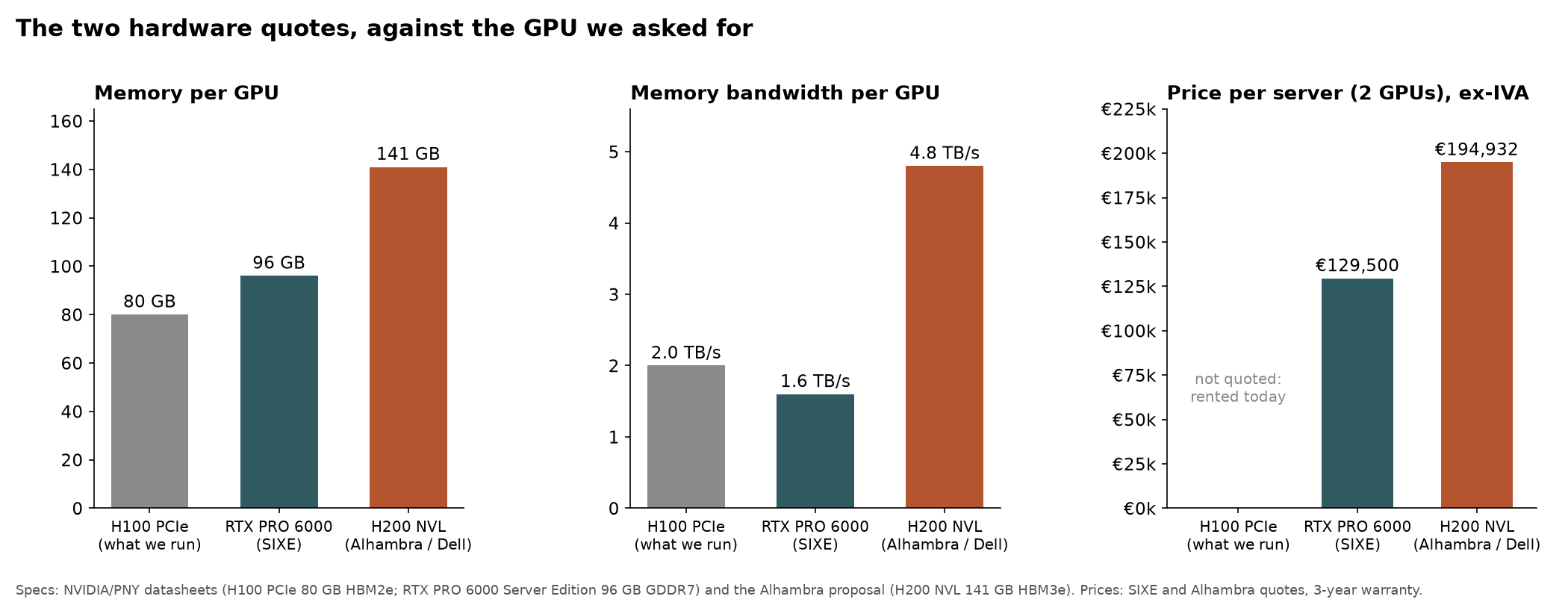
Neither option is a straight swap for what we run, and the difference is easy to miss if you only compare memory.
The RTX PRO 6000 has more memory than an H100 PCIe, 96 GB against 80. But it uses GDDR7 rather than HBM, and its bandwidth is about 1.6 TB/s, according to PNY's datasheet, against 2.0 TB/s for the H100 PCIe. When a language model generates text, each new token requires reading the model's weights from memory, so bandwidth often sets the speed. For some of our workloads, the cheaper card could be slower than the one we have.
The H200 NVL is a large step up: 141 GB of HBM3e and 4.8 TB/s, according to the Alhambra proposal. It also costs 50% more per server. We would be paying for capacity we do not need yet.
The terms were as important as the specs:
SIXE wanted 100% of the payment at order. No staged or net terms. They said leasing might be possible.
The quote was valid for 12 days, from September 18 to September 30.
Lead times ranged from two to three weeks for configurations in stock to five or six months for others.
The price excluded transceivers, DAC cables, switches, rack installation, the operating system and software licences.
Both sides of the market got more expensive
Our June model assumed about €75,241 per server, based on public H100 server pricing at the time. SIXE's quote came in at €129,500, 72% higher.
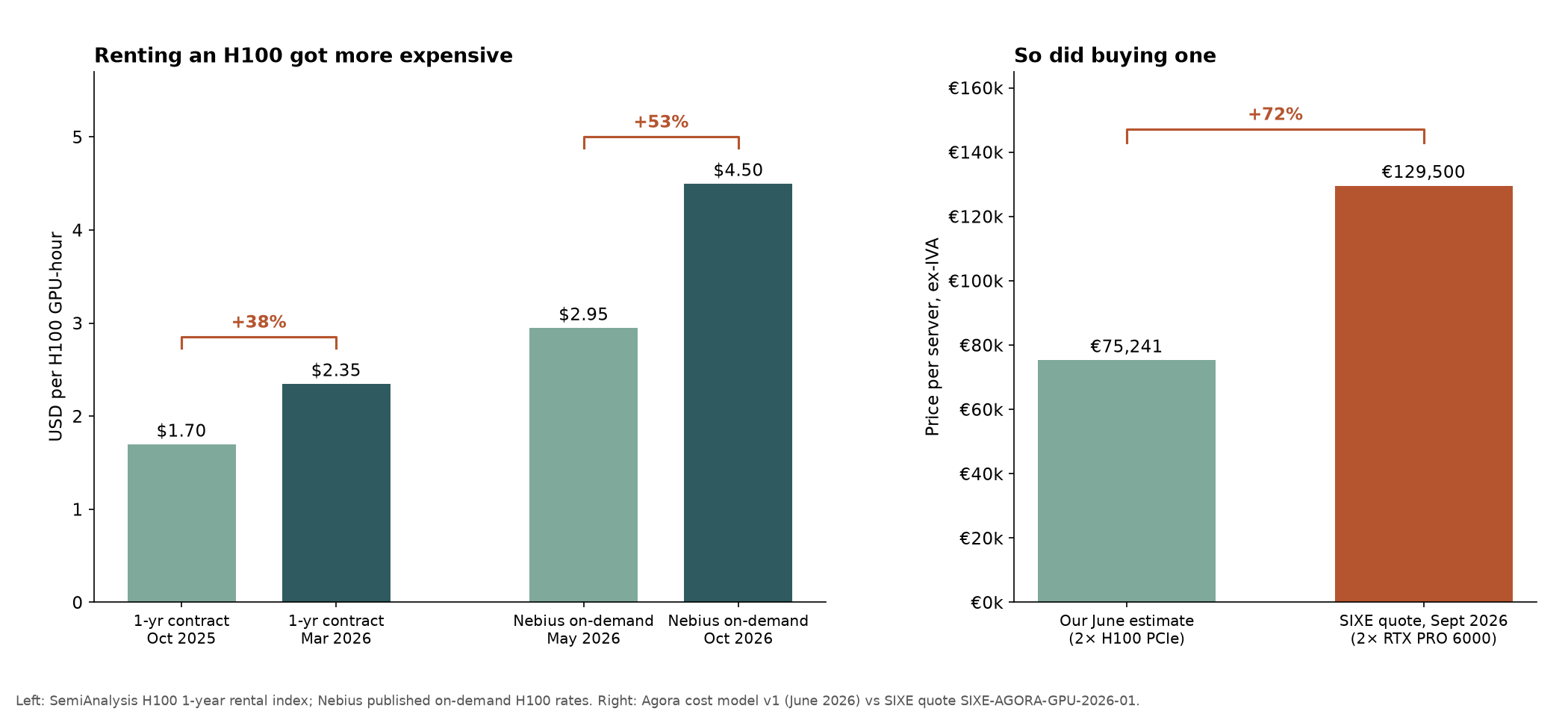
Some of that gap is our own doing. The quote has more memory than we specified (1 TB against 768 GB) and a different GPU. But much of it is the market. Memory makers have shifted capacity toward high-bandwidth memory for AI accelerators, and conventional server memory has been short all year. TrendForce expects conventional DRAM contract prices to rise another 10 to 15% in the fourth quarter of 2026, and Micron expects the shortage to get worse in 2027 and 2028, according to CIO.
This matters for anyone doing the same exercise. Rising rental prices are a reason to look at buying. But the same shortage that pushes rents up also pushes server prices up. The gap you are hoping to capture is smaller than either number suggests on its own.
How the model works
The model is a plain spreadsheet with five tabs. We kept it simple on purpose, so anyone at the company could change an input and see the result.
Assumptions. Every input in one place: number of servers, GPUs per server, server price, rack costs, colocation, tax, our current rental bill, and the migration overlap. Inputs are blue. A toggle picks which hardware quote and which colocation quote feed the rest.
Quotes. Each hardware and colocation quote as received, with notes on what is missing.
Hardware. The one-off purchase, including installation and IVA.
Running costs. Colocation, cross-connects, bandwidth, remote hands and support, per month and per year.
Buy versus rent. Nine years of cumulative cost for each path, and the difference.
Euros are converted at 1.12 dollars. The base case uses SIXE hardware and Digital Realty colocation with Colt internet.
What it costs to own
Amount | |
|---|---|
Two servers, before IVA | $290,080 |
Racking and installation | $2,565 |
IVA at 21%, not recoverable | $61,455 |
Upfront hardware | $354,100 |
Three months of rent while we migrate | $21,600 |
Cash out before the first saving | $375,700 |
Colocation, per year | $26,544 |
Cross-connects, per year | $3,091 |
Internet, per year | $10,214 |
Running cost, per year | $39,850 |
Rent today, per year | $86,400 |
Saving, per year | $46,550 |
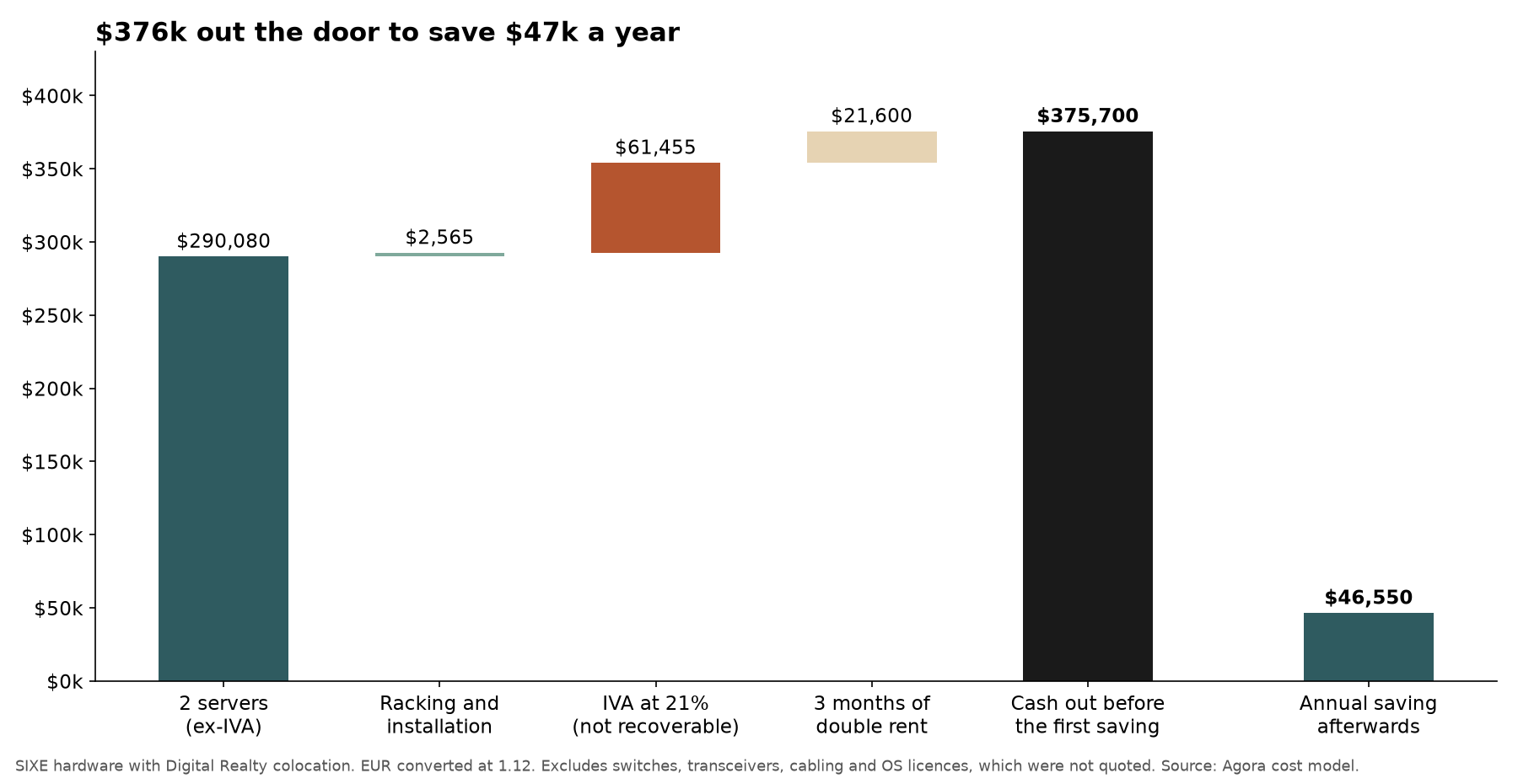
Two lines deserve a note.
IVA is a real cost for us. Search Agora, Inc. is a Delaware corporation with no Spanish VAT registration. Non-EU businesses can sometimes reclaim Spanish VAT, but Spain requires reciprocity, and the European Commission's summary of Spain's rules lists reciprocity with Canada, Monaco, Japan, Norway, Switzerland and Israel only. In April 2026 the Spanish tax authority confirmed that US businesses can claim refunds in a narrow set of cases where reciprocity is not required, according to DLA Piper. Buying servers for our own use is not one of them. So the $61,455 is money we would not get back. This is our reading, not tax advice; check your own position.
Migration is not free. Moving production inference and daily training to new hardware takes time. We assumed three months of paying both bills while we cut over. That is an estimate.
The result
Year | Own, cumulative | Rent, cumulative | Difference |
|---|---|---|---|
1 | $415,550 | $86,400 | −$329,150 |
3 | $495,249 | $259,200 | −$236,049 |
5 | $574,948 | $432,000 | −$142,948 |
8 | $694,497 | $691,200 | −$3,297 |
9 | $734,347 | $777,600 | +$43,253 |
Buying catches up with renting about one month into year nine. By then the servers would be four years past their warranty and three years past a standard five-year useful life.
The Dell option is worse. Two XE7740s with H200s cost $531,447 upfront with the three-year warranty. Running costs are about the same, so payback takes roughly twelve years. The five-year warranty version costs $570,448 and takes nearly thirteen.
Stress-testing the answer
A single payback number hides a lot of assumptions. So we changed them one at a time to see which ones mattered.
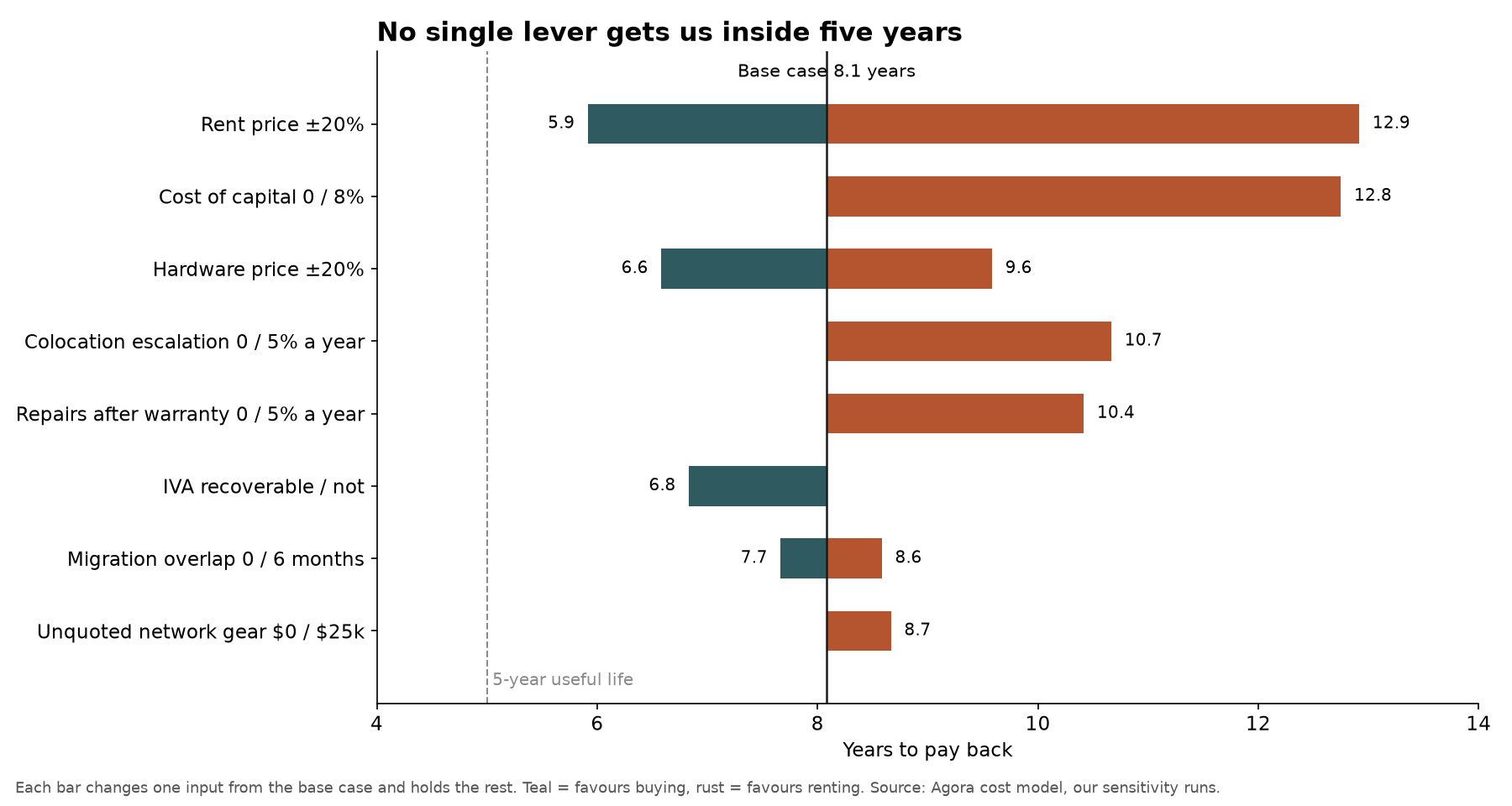
What helps buying:
Rent 20% higher: payback falls to 5.9 years.
Hardware 20% cheaper: 6.6 years.
Recovering the IVA, for example through a Spanish entity: 6.8 years.
No migration overlap: 7.7 years.
What hurts it:
Rent 20% lower, for example through a committed-term discount: 12.9 years.
An 8% cost of capital: 12.8 years. Cash has a price, especially for a startup.
5% annual escalation on colocation: 10.7 years.
Repairs at 5% of hardware value per year after warranty: 10.4 years. The base case assumes $0.
$25,000 of switches, optics and spares that nobody has quoted yet: 8.7 years.
The most favourable single change still leaves payback at almost six years. Getting comfortably under five takes three favourable changes at once: rent 20% higher, hardware 20% cheaper and the IVA recovered. Even then, it assumes nothing breaks after the warranty.
We also tried two structural changes: a different data center, and a bigger fleet.
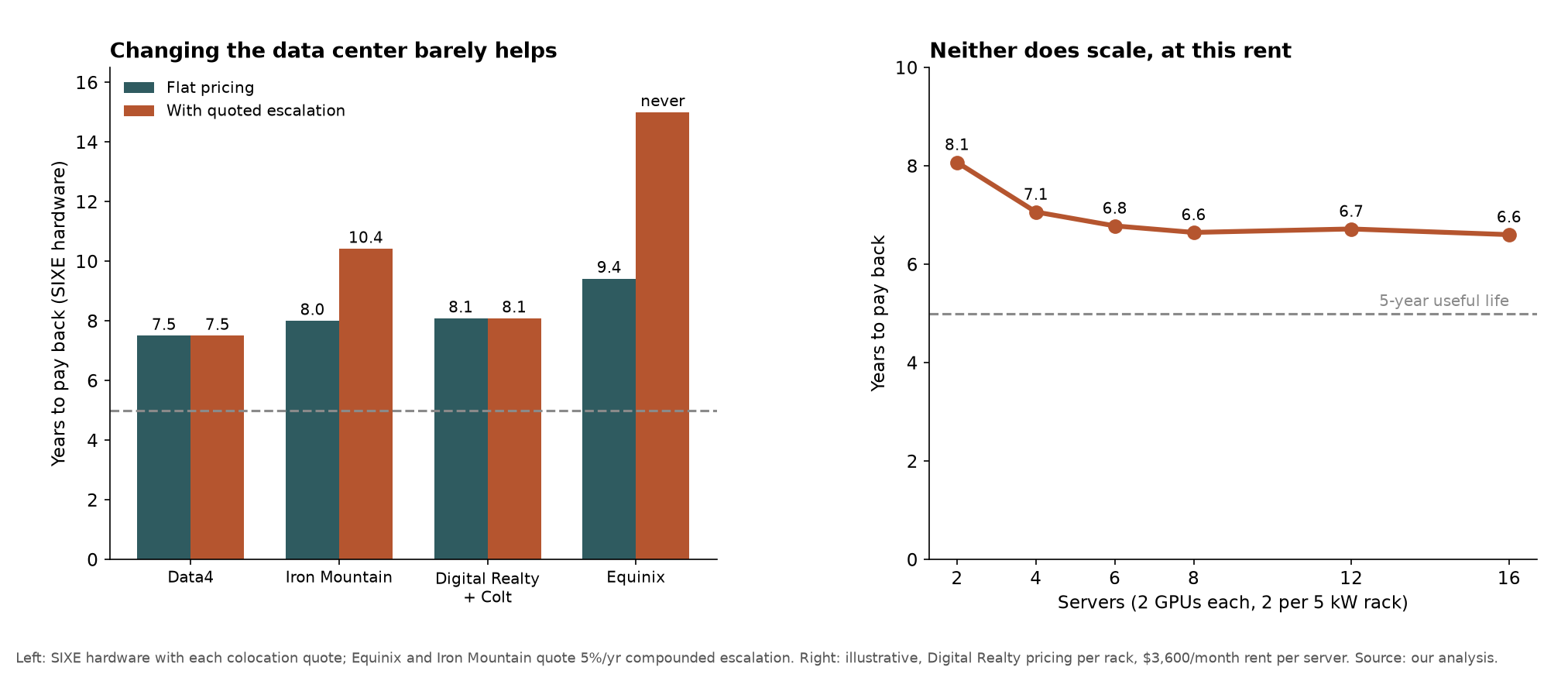
The data center barely matters. With flat pricing, the four colocation quotes give paybacks between 7.5 years (Data4) and 9.4 years (Equinix). With the 5% escalators that Iron Mountain and Equinix quoted, Iron Mountain stretches to 10.4 years and Equinix never pays back: its running costs climb toward the rent before the upfront cost is recovered.
Scale does not fix it either. If we grew to eight or sixteen servers, the fixed costs of cross-connects and internet would be spread more thinly. Payback improves from 8.1 years to about 6.6, then flattens. The hardware is most of the cost, and it scales linearly. This curve is illustrative: it assumes two servers per 5 kW rack at Digital Realty prices and the same rent per server.
What the model leaves out
Some risks are hard to put in a spreadsheet. These were the ones that weighed on us most.
Obsolescence. NVIDIA now ships a new data center architecture roughly every year. Vera Rubin began production shipments this fall, according to NVIDIA. How long a GPU stays economically useful is a live argument. Large cloud providers depreciate servers over about six years, while critics such as Michael Burry argue the real life is two to three, as CNBC reported. We do not know who is right. We do know that a nine-year payback assumes the most optimistic answer, and then some. When we rent, the reinvestment in new GPUs is our provider's problem.
Repairs. The warranties cover three years, or five with the more expensive Dell option. After that, any failure is ours. At two servers, we cannot keep a spare GPU on the shelf. A single failed card would take a quarter of our capacity offline until a replacement arrives.
Cash. Buying ties up more than $350,000 at once. For a company our size, that is runway. It is money we could spend on people or on growth, and we would be spending it to save $46,550 a year.
Spec and timing. We did not get the GPU we asked for, the quote expired in 12 days, and lead times ran up to six months. A purchase this size should not be rushed by a quote's validity date.
People. Owning hardware means someone has to rack it, cable it, patch it, and get paged when it fails. Remote hands cost €165 to €200 an hour in these quotes. The model does not include any of our own time.
Owning has real advantages too, and we want to be fair to them. Our costs would be fixed. No one could raise our rent, which several GPU clouds did this year. Our data and models would sit on hardware we control. The servers would have some resale value, which the model sets at zero. And SIXE's chassis has two free GPU slots, so adding capacity later would cost less than buying a new server. These are good reasons. At our rent, they are not enough to close a nine-year gap.
How we decided
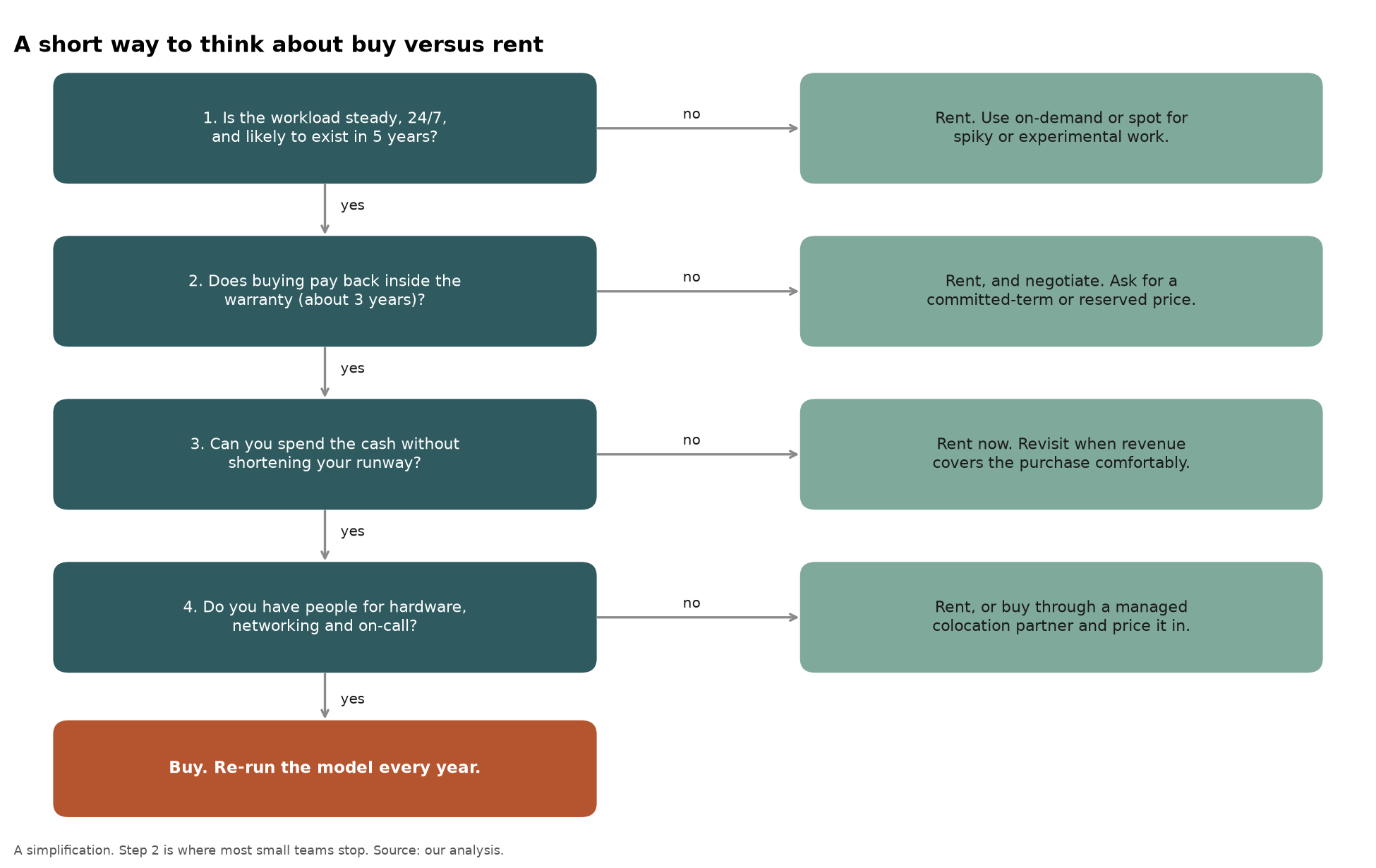
We set one rule before we saw the final numbers: a purchase should pay for itself inside the warranty. A three-year warranty is the period in which the hardware's cost is predictable. After that, every year adds repair risk and obsolescence risk that the model does not price.
Neither option came close. The cheapest pays back in just over eight years, and the most capable in nearly twelve. Our operations team recommended that we stay with our current provider and use what we had learned to negotiate a committed-term price. We agreed.
The process was still worth doing. We now know what our compute would cost to own, line by line, in today's market. That makes us a better-informed customer. It also gives us a clear set of conditions under which we would look again:
Our all-in rent rises above about $3.30 per GPU-hour. At that rate, the same purchase pays back within five years.
Server prices fall meaningfully as the memory shortage eases.
We set up a Spanish entity that can recover IVA.
Our steady, 24/7 GPU load grows enough that a managed colocation deal at volume changes the running costs.
How to think about it for your company
Every team's numbers will differ. The structure of the decision probably will not. Here is what we would tell a founder or engineering manager starting the same exercise.
Start with your effective rate. Take your monthly GPU bill and divide it by the number of GPUs times 730 hours. That single number explains most of the answer.
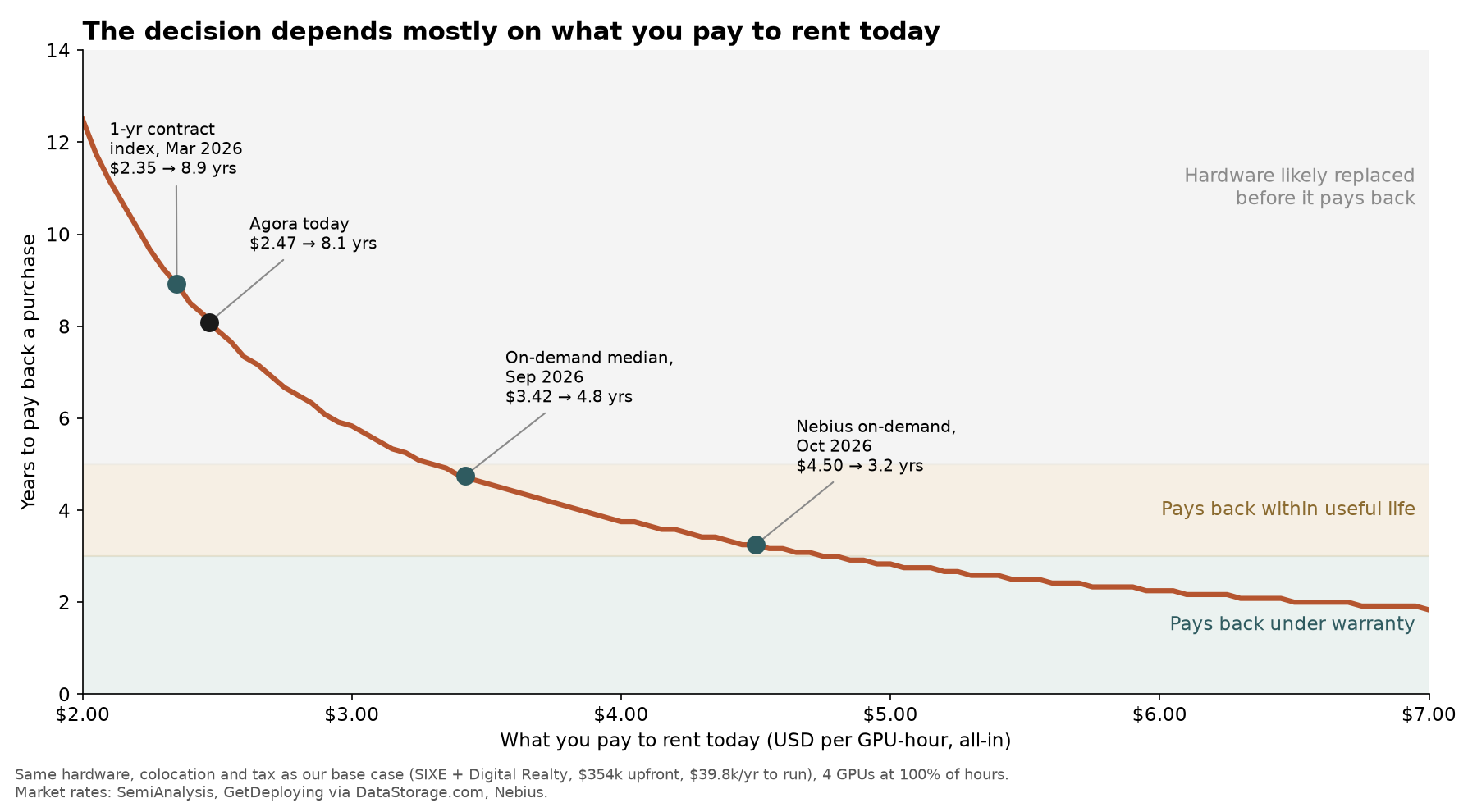
Using our hardware and colocation quotes, the payback curve looks like this:
What you pay to rent, per GPU-hour | Payback |
|---|---|
$2.35 (one-year contract index, March 2026) | 8.9 years |
$2.47 (Agora today) | 8.1 years |
$3.00 | 5.8 years |
$3.42 (on-demand median, September 2026) | 4.8 years |
$4.50 (Nebius on-demand, October 2026) | 3.2 years |
$6.00 | 2.3 years |
If you are paying on-demand prices at a large cloud provider, buying probably looks good on paper. If you have already negotiated a good rate with a specialist GPU cloud, it probably does not. Much of the "owning is cheaper" story comes from people comparing purchases against list prices.
Judge payback against the warranty, not the accounting life. A five- or six-year depreciation schedule is an accounting choice. Whether the hardware is still worth running in year five depends on what NVIDIA ships in the meantime.
Get real quotes early. Our estimate was 72% too low. A model built on list prices or last year's blog posts will give you the wrong answer with great confidence.
Count everything. Tax you cannot recover. Months of paying both bills. Switches, optics and cables that are not in the server quote. Remote hands. Annual escalation. Repairs after the warranty. Each one is small. Together they moved our payback by years.
Compare GPUs on bandwidth, not just memory. A card with more memory and less bandwidth can be slower for inference. Benchmark your own workload on the hardware you are being offered.
Price your cash. At an 8% cost of capital, our payback moved from 8 to almost 13 years. If the money would otherwise extend your runway, it is not free.
Read the terms, not just the total. Minimum term, escalation, ramp schedules, and what happens when you need more power matter more than a few hundred euros a month.
Use the quotes. Even if you do not buy, a detailed quote for owning tells your current provider exactly what your alternative costs. That is useful in a negotiation.
Know when buying does win. It wins when rent is high, the workload is steady around the clock, the models you serve will still be running in five years, you have people who want to run hardware, and the purchase does not threaten your runway. 37signals is a good example. They were replacing general-purpose cloud servers, where the markup over owned hardware is large and the hardware lasts for years, and they had the cash to buy. GPUs in 2026 are a different market: the hardware turns over every year, and specialist clouds compete hard on price.
What we are doing next
We are staying with rented GPUs for now, and we will re-run the model whenever one of the conditions above changes. The spreadsheet takes a few minutes to update, and the quotes give us a current view of the Madrid market.
We would like to hear how other teams have approached this, especially anyone who has bought GPUs at a similar scale and can share how the first few years went.
Appendix: assumptions
Input | Base case | Source |
|---|---|---|
Servers | 2 | Replaces the 2 servers we rent |
GPUs per server | 2 (4 slots) | SIXE quote |
Server price | €129,500 before IVA | SIXE quote, September 18, 2026 |
Racking and installation | €2,290 | Digital Realty setup fee plus cross-connect installation |
IVA | 21%, not recoverable | No Spanish VAT registration |
Colocation, 5 kW | €1,975 a month | Digital Realty |
Cross-connects | €230 a month | Digital Realty, 2 at €115 |
Internet, 1 Gbps | €760 a month | Colt, at Digital Realty |
Remote hands, support, repairs | €0 | Not modelled |
Rent today | $7,200 a month | Current provider, both servers |
Migration overlap | 3 months | Estimate |
Exchange rate | 1.12 USD per EUR | Model assumption |
Warranty | 3 years | SIXE quote |
Useful life | 5 years | Standard assumption |
All vendor prices come from the quotes we received between August and October 2026 and exclude IVA unless noted.


